How to build a Flourishing Life, actually
This is for you (specifically).
Your life is fine.
The kind of okay that sounds almost ungrateful to name, which makes it harder to fix.
You have a job that mostly works.
A social life that mostly works.
A body you’ve been meaning to take better care of since last year, maybe the year before that.
You’ve done the self-improvement things in short bursts.
Tracked your macros for two weeks, meditated for three days in a row, started four books but finished one, and bought a planner you stopped using in a few days.
None of it stuck and nothing is obviously wrong. Which is the specific problem this newsletter addresses.
When your life isn’t broken enough to fix with a dramatic intervention, and you know clearly that it isn’t what it could be.
You’ve been making roughly the right moves but just been making them toward the wrong target.
This is a 30-day reset built around a framework that has held up for over 2000 years, and a clear explanation of what you’ve actually been trying to build toward this entire time.

Some Truths That Sound Extreme but Aren’t
Before the framework, a few things are worth sitting with.
Most of what people call self-improvement is organized procrastination from actually living.
Upgrading your routines is a fine activity, but it’s a terrible substitute for a life. When the process of improving your life becomes the life itself, something has gone wrong.
Happiness is a genuinely bad goal not a bad side effect, a bad goal. The people most organized around feeling good at all times are consistently among the least well.
The man with the best available framework for your life died in 322 BCE. His name was Aristotle. He spent his career systematically working out what human flourishing requires and doesn’t require. Nobody has meaningfully improved on his answer in 2000 years. They’ve mostly just simplified it into things that don’t work.
You do not need a better life to start living well but enough stability to stop sabotaging yourself. The bar is lower and the start date is earlier than you’ve been assuming.
Who you used to be cannot protect you. You are who you consistently act as right now.
What’s Actually Not Working
Let’s name the specific failure modes the ones keeping people in midlife despite genuine effort.
The Optimization Trap
The dominant script for improving your life runs roughly as follows:
Optimize your body, grow your income, expand your social presence, and minimize discomfort. Do these things at maximum intensity. If something doesn’t move a metric, cut it.
This produces a particular kind of person. Attractive by external measures. Financially operational. Socially present. And frequently, despite all of it, hollow.
Not miserable in an obvious way. Just unmistakably not alive in the way they expect to feel after doing everything right.
The Dopamine Loop
There is a version of daily life that is technically full of enjoyment and effectively empty of meaning. Scrolling, eating, watching, repeating.
Every individual moment is fine but the cumulative effect is the sense of having spent the day, and the week, and eventually the years, without building anything.
The dopamine system that motivates genuine achievement also responds to cheap substitutes and the cheap substitutes have been engineered by entire industries to be more immediately compelling than anything requiring sustained effort.
The loop doesn’t feel like a problem while you’re in it. It only becomes visible in aggregate: when you look back at a month, or a year, and the balance sheet is empty.
The Deferral Pattern

When I have X, I’ll start really living.
When things settle down at work.
When I’m in better shape.
When I have more money.
When I’ve figured out what I’m doing with my life.
The deferral pattern feels responsible like you’re not avoiding the work but rather you’re waiting for the right conditions.
But the right conditions are, by design, always slightly ahead of wherever you currently are. Life lived in permanent preparation for life is not life.
The Knowing-Doing Gap

You already know, roughly, what would make your life better.
More movement.
Less scrolling.
Deeper relationships.
More meaningful work.
You know and most people know.
Without a clear, honest account of what you’re actually building toward, every attempt to change behavior runs without a target. You get motivated and take some steps, lose the thread, but return to baseline.
The framework you’re missing is what the rest of this newsletter is here to provide.
The Reframe That Changes Everything
 Around 350 BCE, Aristotle asked the question the entire self-improvement industry has been trying to answer since, largely failing:
What is the best life actually made of?
He started where every honest inquiry starts with and that is “what people actually want”.
Run this five-why chain on anything you desire.
You want the job. Why? You want the money. Why? You want the car. Why? You want to seem successful. Why? You want to feel good about yourself. Why?
To be happy.
Every chain ends in the same place. Which means happiness in some sense is the terminal goal and the one thing people are chasing through everything else.
The reframe most people never encounter: happiness in the sense most people mean it is not actually what they want.
What they want is something more durable than a feeling and chasing the feeling is one of the most reliable ways to miss the thing itself.
Aristotle’s word for the actual target is eudaimonia. It’s usually translated as “happiness” which is why most people miss what he’s saying.
A better translation is flourishing or living well.
The distinction is structural:
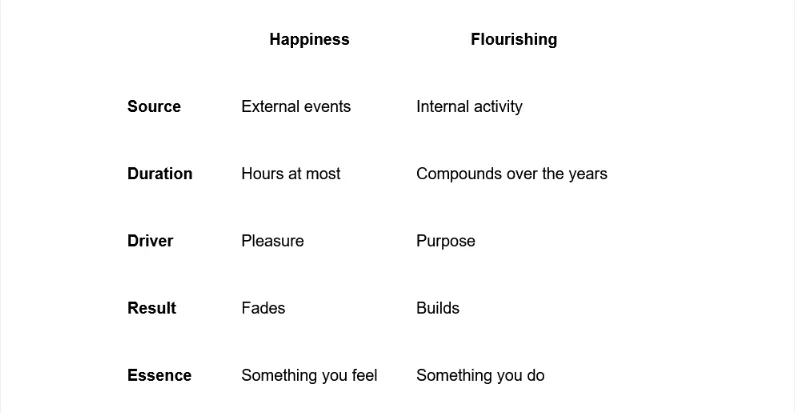 Happiness is a feeling you have but Flourishing is an activity you perform.
This changes everything about how you approach the problem.
If flourishing is a feeling, your strategy is to arrange circumstances so you feel it more often.
If flourishing is an activity, your strategy is to perform the activities that constitute it consistently over time with excellence.
Aristotle is explicit on this point a person who has all the virtues and capacities for flourishing but is currently asleep is not flourishing.
A successful entrepreneur who built something extraordinary but has coasted for a decade is no longer flourishing and no longer is an entrepreneur.
Flourishing is not a status you achieve and maintain. It is something you either do or fail to do in each period of your life.
You’re either doing it or you’re not. And you can start today.
The Framework and the Reset
Aristotle did not stop at the philosophical insight. He also specified with unusual precision what flourishing actually requires and what it doesn’t.
This is where the framework becomes operational.

The Three Buckets
He identifies three categories of goods that human flourishing runs on.
Think of them as buckets that all need to be adequately filled before you can build anything meaningful on top of them.

Bucket One: Bodily Goods
- health
- vitality
- functional physical maintenance and
- reasonable longevity.
Aristotle is not prescribing body optimization.
He is identifying a floor chronic illness, physical depletion and active self-damage undermine everything else.
The floor matters but the ceiling above a certain point stops contributing.
The looksmaxxing movement technically operates in this bucket and inverts the logic entirely.
Caring for your body for genuine health and vitality is a bodily good but organizing your life around your appearance for social comparison is a different activity entirely, one that actively drains the other two buckets while returning nothing to this one.

Bucket Two: External Goods
- enough resources
- a functional living situation
- financial stability that isn’t consuming your cognitive bandwidth and
- genuine relationships.
The qualifier again is to be enough and not maximum.
Aristotle says that wealth beyond what supports a good life adds nothing to flourishing. The marginal return of additional resources past a certain threshold is effectively zero. What this bucket requires is ground solid enough to stand on.
On relationships: Aristotle argues humans cannot fully flourish in isolation. He distinguishes between friendships of utility (transactional and fragile), friendships of pleasure (common and fleeting), and what he calls complete friendships (rare, built on genuine mutual recognition of character, and the kind that actually sustain a flourishing life).
You cannot have many of these but you need some.
The person with 10,000 followers and no close friends has an empty external-goods bucket regardless of the metrics.

Bucket Three: Soul Goods
- learning
- meaningful work or contribution and
- authentic connection
The development of practical wisdom is the cultivated ability to perceive what each situation genuinely requires and respond with appropriate excellence.
This is where the actual return on a human life lives.
The first two buckets exist to make this one possible. A life that has secured the bodily and external goods but never seriously invested in the soul’s goods has, in Aristotle’s account, built the infrastructure and left the rooms empty.
The three buckets are not a checklist to complete. They are a diagnostic tool. The weakest bucket sets the ceiling.
Fix the bottleneck before adding complexity elsewhere.
The Excellence Test
Filling the buckets isn’t sufficient but how you fill them determines whether you’re actually flourishing.
Aristotle argues that excellence in any activity is not found at the maximum but at the mean between two extremes.
Courage is not fearlessness or cowardice.
It is a strategic action taken when appropriate with awareness of the stakes.
Generosity is not stinginess or recklessness.
It is giving the right amount to the right person at the right time.
Maxing out any category is not excellent.
Overtraining until you’re injured is not virtuous in the bodily bucket.
Maximizing social connections at the expense of deep ones is not a virtue in the external bucket.
Performing soul goods for external validation rather than genuine development is not a virtue in the soul bucket.
Aristotle specifies six criteria for a practical test for whether any action is being done with excellence:
- Is it the right thing to do?
- In the right context or toward the right person?
- In the right amount?
- At the right time?
- In the right way?
- For the right reason?
Miss any one and the action stops being excellent, regardless of how it looks from the outside.
The six criteria apply to everything, which means the same action performed differently produces completely different results.
The 30-Day Reset
The reset is structured around the three buckets. Each week has a specific purpose.
Before You Start: The Audit (30 minutes)
Honestly assess each bucket accurately.
Bodily: How is your sleep? Are you moving your body daily? Is your diet broadly functional?
External: Is your financial situation stable enough not to consume your attention? Do you have at least one relationship you’d describe as genuinely good?
Soul: Are you learning anything? Is your work meaningful in any sense? Do you have any reflective practice, reading, journaling, or any real conversation?
Identify the most depleted bucket and start there.
Week One: The Floor (days 1–7)
One minimum viable practice per bucket. Simple enough to execute on your worst day.
Bodily: Seven hours of sleep, five nights out of seven. Twenty minutes of daily movement (a walk also counts). The objective is to make daily movement the default and not the exception.
External: One action this week that addresses a specific friction point. It can be financial, relational, or environmental.
Soul: Ten pages of a genuinely challenging book (daily).
Stack each practice onto an existing anchor behavior. After morning coffee, open the book and after dinner, take a walk.
The new practice uses the anchor as its trigger reducing the activation energy required to begin.
Track simply “done or not done” each day.
Expect week one to feel manageable because novelty carries you and does not accelerate ahead of the schedule.
You are building the floor and not testing the ceiling.
Week Two: Adding the Mean (days 8–14)
Motivation drops around day ten and the novelty on these days is gone and the practices begin to feel like work rather than fresh choices.
What carries you through week two is not enthusiasm but it is the beginning of identity formation. You are doing these things because this is who you are building yourself to be.
For each bucket identify the current extreme. Overtraining or sedentary? Maximum social surface area or isolated? Consuming content without generating anything? Move one degree toward the mean.
Add ten minutes of written reflection at the end of each day (honest and brief not performative).
What happened today in each bucket? Where was the mean honored? Where was it missed?
Week Three: Running the Excellence Test (days 15–21)
Apply the six criteria to your own practice.
Are you doing the right things in the right amounts and for the right reasons?
The most common week-three discovery.
People realize their soul practices are being done for the wrong reasons, for the streak, for the identity signal, for how it makes them look to themselves.
The right reason is that the practice is genuinely building capacity to understand, judge, and act well.
Week three is where meaningful change either consolidates or collapses.
Week Four: Integration (Days 22–30)
By week four the practices should require noticeably less willpower than week one because you’ve begun building the identity that makes them feel characteristic rather than effortful.
Assess each bucket honestly. What is actually better? and what remains the bottleneck?
Thirty days is a launch window but not the destination.
The point where a practice requires minimal conscious effort typically takes closer to 66 days of consistent repetition.
What the first 30 accomplish is this: you prove you can sustain it, the pattern is established, and the identity shifts from someone trying to toward someone who.
The One Thing to Walk Away With
Aristotle’s answer distilled to its core:
Flourishing is the active exercise of your best capacities, in the right circumstances, over a complete life. You can start building it from wherever you currently are.
With the three buckets at whatever level they’re actually at right now.
The past doesn’t save you.
The version of you who used to be disciplined or creative or focused that version doesn’t count unless you’re acting as that person today.
But the present doesn’t lock you in either.
You’re not trapped by the midlife you’ve been living. What you do consistently starting today is who you are becoming.
The reset is 30 days but the framework is two thousand years old and the start date is today.